No. 17: Emergency Treatment for Snake Bite and Dog Bite
Aim
To study and demonstrate emergency treatment for snake bites and dog bites and prepare a poster of Do’s and Don’ts after experiencing a snake bite or dog bite.
Practical Significance
As a health professional, pharmacists should have knowledge of managing snake bites and dog bites, both of which are life-threatening emergencies requiring prompt treatment. The pharmacist’s role includes educating the community on first aid measures for snake bites and dog bites, ensuring that victims can quickly reach medical facilities in optimal condition. In this practical, students will learn about emergency treatment for snake bite and dog bite victims, and they will also create educational materials to raise awareness about these treatments in society.
Theory:
A. Snake Bite
There are approximately 2500 different varieties of snakes, and snake bites can have varying effects depending on the species involved. While not all snakes are venomous, and not all venomous snakes are necessarily dangerous, it’s crucial for those living in areas with snakes to exercise caution. Snake bites should always be treated as potentially poisonous, as snakes typically bite when they feel threatened or disturbed.
Symptoms of a snake bite can include bleeding, swelling, staining, pain, numbness, weakness, confusion, impaired vision or speech, nausea or vomiting, cardiac arrest, or difficulty breathing.
Emergency steps for snake bite
- Ensure the area is safe before assisting the victim.
- Provide immediate aid to the injured person. If you’re alone, call for help loudly, but do not leave the person unattended. Ask a bystander for assistance or arrange for urgent transportation to the nearest medical facility. Instruct them to inform you once medical help has been secured.
- Comfort the victim by helping them lie down and advising them not to move. Offer reassurance and encourage the victim to remain calm, avoiding forceful restraint. Explain that remaining still can slow the spread of venom. If safe, identify the type of snake that bit the victim. If possible, take a photograph of the snake. Do not waste time trying to track down the snake, as the priority is getting immediate help. Always assume the snake is poisonous.
- Monitor the person for any changes in their condition, such as consciousness level or breathing.
- If available, wear gloves. If not, use a clean plastic bag to protect your hands.
- Remove any rings, watches, or tight clothing that could hinder blood flow due to swelling.
- Avoid moving the bitten limb.
- Apply a tight pressure bandage over the bite site, extending it as high as possible on the limb without removing clothing (refer to Figure 17.1-a, b, c). Use a splint to immobilize the limb while applying the bandage (refer to Figure 17.1-d, e). If the snake bit the forearm, immobilize the arm with a splint or cloth sling after applying the bandage (refer to Figure 17.1-f).
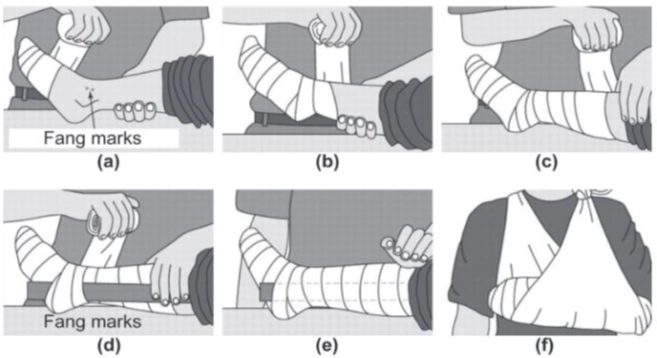
Figure 17.1: Use of pressure bandage, splint and sling as first aid for snake bite.
- After calling for medical assistance, remain with the injured person until help arrives.
- Monitor the person’s condition, including their level of consciousness and breathing.
- If the victim loses consciousness but is still breathing, place them in the recovery position and continue to monitor their breathing.
- If the person stops breathing, administer CPR (Cardiopulmonary resuscitation).
- Organize immediate transportation to the nearest medical facility or hospital. If the snake has been killed, bring it along to the dispensary or hospital with the patient for identification by the doctor.
Steps to avoid while treating a snake bite victim:
- Avoid direct contact with the person’s blood.
- Do not wash the wound.
- Refrain (stop doing) from attempting to suck out the venom.
- Do not cut the bitten area.
- Avoid applying traditional herbs directly on the wound.
- Do not use a tourniquet.
- Avoid applying heat or cold to the affected area.
- Do not give any food or drink to the victim by mouth.
- Avoid elevating the bite site above the level of the victim’s heart.
- Remember that even a detached snake head can still deliver a bite, so do not handle the snake with bare hands.
Preventive measures for avoiding snake bites:
- Avoid areas where snakes are commonly found.
- Do not disturb or provoke snakes if encountered.
- Wear closed shoes when in snake-prone areas.
- Maintain well-mowed grass and clear vegetation around living spaces.
- Use a flashlight or torch when walking outdoors, especially at night, to spot snakes and avoid surprises.
B. Dog Bite
Any bite that breaks the skin, whether from an animal or human, requires immediate medical attention due to the high risk of infection. Several animals, including dogs, cats, monkeys, foxes, bats, cows, horses, and jackals, can carry the rabies virus. However, in India, dog bites are the primary cause of rabies infections. Rabies is a viral disease that affects the brain and nervous system. When bitten or scratched by an infected dog, a person can contract rabies. Without prompt treatment, the disease is fatal.
Complications that can arise from dog bites include bacterial infections, damage to nerves and muscles, fractures, rabies infection, tetanus, scarring, and in severe cases, death. Therefore, all individuals bitten or scratched by dogs should seek medical attention immediately and follow up with appropriate treatment.
Emergency steps for a dog bite:
- Ensure that the area is safe, and that the animal cannot bite you or the victim again.
- Wash your hands thoroughly before and after assisting the victim with soap and water. If soap is not available, ash can be used. Alcohol-based sanitizers are also suitable.
- If gloves are available, use them. Otherwise, a clean plastic bag can be used to avoid direct contact with the blood or wounds.
- Flush the wound with plenty of clean water to remove the rabies virus and wash it with soap, water, or detergent for 10-15 minutes. If possible, use povidone-iodine solution for washing. This applies to licks, scratch, or abrasion wounds as well.
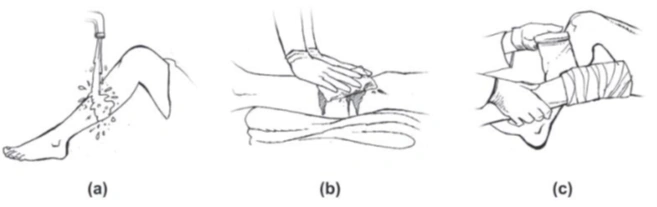
- Apply pressure to the wound to stop severe bleeding.
- Cover the wound with a dry, clean cloth or bandage.
- Immediately refer the person to a healthcare facility for further treatment.
Steps to avoid while treating a dog bite victim:
- Do not enlarge the wound by cutting it.
- Avoid putting herbs or unclean materials like chilies, oil, or petrol on or in the wound.
Preventive measures:
- Avoid approaching unfamiliar dogs.
- Refrain from screaming and running away from dogs.
- Stay still if approached by an unfamiliar dog.
- If a dog knocks you over, curl up into a ball and remain still.
- Supervise children when playing with dogs.
- Report strays or suspicious dogs to adults immediately.
- Avoid direct eye contact when interacting with a dog.
- Respect a dog’s space when sleeping, eating, or caring for puppies.
- Allow a dog to see and smell you before petting it.
Procedure:
Create a chart/poster (on card-sheet/ A3 or A4 paper) containing pictorial and textual information about do’s and don’ts during snake or dog bite first aid treatment.
Result
First aid measures or snake and dog bite were studied and educational material was prepared.
