No. 15: First Aid-Theory, basics, demonstration, hands on training, audio-visuals and practice, BLS systems. – FBAO
Aim:
To study and demonstrate the first aid measures to be taken if an adult/child/infant suffers from foreign body airway obstruction (FBAO) and prepare the poster on steps to be taken to remove the airway obstruction.
Practical Significance:
An airway obstruction caused by a foreign body is a medical emergency that can be fatal. Pharmacists must create awareness in society about the first aid measures to be taken if someone suffers from foreign body airway obstruction. In this practical, students will learn how to provide first-aid treatment and save the life of an adult, child, or infant suffering from foreign body airway obstruction, enabling them to educate society about these measures.
Theory:
Asphyxia caused by foreign body airway obstruction (FBAO) is a serious condition that arises suddenly, leaving the patient unable to describe their distress. Without prompt and effective first aid, it can lead to rapid loss of consciousness and death. Therefore, quick recognition and response are crucial.
Choking typically occurs when a person ingests a foreign object while eating. To ascertain if someone is choking, it’s important to ask them directly, as they may be unable to communicate verbally. Observing specific signs can also help determine the cause:
- Choking often happens during a meal with a sudden onset.
- Adults may clutch their neck or point to their throat.
- Children may exhibit clues such as playing with small objects before symptoms appear.
The “Five and Five” technique is recommended as first aid for foreign body airway obstruction, involving five back blows followed by five abdominal thrusts. This method is highly effective in clearing blocked airways.
Here are the steps to relieve choking in adults (according to the First Aid manual of the Indian Red Cross Society):
- Encourage the person to keep coughing. Stay with them until they can breathe normally.
- If coughing doesn’t help or the person can’t cough or breathe, stand behind them and slightly to one side.
- Support their chest with one hand and lean them forward.
- Deliver five firm blows between their shoulder blades using the heel of your free hand. Check if the object has been dislodged and the person can breathe again.
- If the object is still lodged and the person is still choking, stand behind them and place both hands around their waist so that both hands meet in front of the person.
- Make a fist and position it between the navel and lower tip of the breastbone. Hold onto this fist with your other hand.
- Bend the choking person forward and pull your fist firmly toward you and upward.
- Give five abdominal thrusts.
- If the air passage is clear, stop giving further abdominal thrusts, but always stop after five abdominal thrusts.
- If the object does not come out and the person is still choking, administer another five back blows followed by five abdominal thrusts.
- Repeat this process until the object is dislodged or until the choking person loses consciousness.
- If the person becomes unconscious, carefully lay them on the floor.
- The person requires urgent assistance. Shout for help or call for assistance if you are alone, but do not leave the person unattended. Ask a bystander to seek help or arrange immediate transportation to the nearest healthcare facility. Instruct them to return to you to confirm if help has been obtained.
- Kneel down beside the person. If they are not on their back, turn them onto their back.
- Initiate the CPR (Cardiopulmonary Resuscitation) procedure.
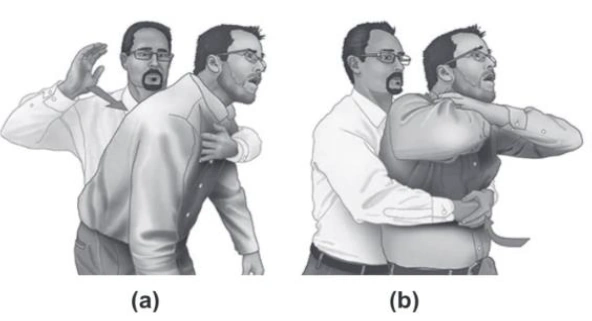
“Five and Five” technique for adults- Back blow (a) and abdominal thrust (b)
Do not interrupt the resuscitation until:
- The victim starts to wake up, moves, opens eyes, and breathes normally.
- Medical emergency arrives and takes over.
- You are too exhausted to continue. or
- The scene becomes unsafe for you to continue.
Steps to relieve choking for children (age>1 year):
- If the child can cough effectively, encourage him/her to cough and mDo not interrupt the resuscitation until
- The baby starts to wake up, moves, opens his eyes, and breathes normally; or
- Medical emergencies arrive and takes over.
- Complications
- Foreign material may remain in the upper or lower airways following effective choking treatment, causing problems such as bronchiectasis or lung abscess later. Anyone who has a prolonged cough, trouble swallowing, or the sense that something is still lodged in their throat should see a doctor.
- The use of abdominal thrusts can result in serious injuries (e.g., gastric and splenic rupture). All victims of abdominal thrusts should have their abdomens examined, especially for internal damage.
- Hypoxic brain injury and death.
- Preventive measures for avoiding foreign body airway obstruction.
- Avoid eating during exercise.
- Chew food properly.
- Avoid giving peanuts or very small objects to children.
- Increase public awareness of choking and confidence in initiating first aid.
- Procedure
- Demonstration of steps to relieve choking in adults and infants.
- The subject teacher must demonstrate the “Five and Five” technique to relieve choking in adults and steps to relieve choking in infants (using a baby manikin/doll) to the students. If a manikin is not available, teachers can use YouTube videos for demonstration. The students will observe the demonstration of five blows and five thrusts given by the teacher. Each student will prepare a poster on first aid measures to be taken if an adult suffers from Foreign Body Airway Obstruction (FBAO).
- Activity I
- Organize students into groups and instruct them to act out a scenario of choking, followed by demonstrating the first aid steps to alleviate the choking. The teacher should assess if the students have correctly applied the “Five and Five” technique on their partners and provide guidance if any errors are noted.
- Activity II
- Prepare the poster on first aid measures to be taken if an adult suffers from Foreign Body Airway Obstruction (FBAO). The poster should serve as an efficient educational/counselling material to the people.
- Result
- The first aid measures for foreign body airway obstruction were studied, and educational materials on how to clear airway obstruction were prepared.onitor continuously.
- If coughing is ineffective, shout for help and assess the child’s level of consciousness.
- If the child is conscious, give up to five back blows, followed by five abdominal thrusts. Repeat the sequence until the obstruction is relieved or the child becomes unconscious. If the child becomes unconscious, follow steps ‘l’ to ‘o’ as for adults.
Steps to relieve choking in infants (age <1 year)
- The baby urgently needs help. Shout or call for help if you are alone but do not leave the child unattended. Ask a bystander to seek help or to arrange urgent transport to the nearest healthcare facility. Tell them to come back to you to confirm if help has been secured.
- Kneel down so that you can use your thighs to prevent the baby from falling.
- Lay the baby down along your forearm (see below Figure). If you are right-handed, use your left forearm; if you are left-handed, use your right forearm.
- Support the baby’s head and neck with one hand without covering the mouth so the baby lies face down with the head below the trunk, over your forearm, supported by your thigh.
- With your free hand, give five firm blows with the base of your palm to the area between the baby’s shoulder blades.
- Quickly turn the baby, while supporting the head, onto their back to face you, resting on your arm.
- Check if the object has come out and the baby can breathe freely.
- Place two fingers (the two after your thumb or two after your index finger) in the middle of the baby’s chest and deliver five thrusts (pushing inwards and upwards). Stop after five thrusts.
- If the object does not come out and the baby is still choking, give another five blows on the back followed by five thrusts.
- Repeat this until the object is released or the choking baby loses consciousness.
- If the baby loses consciousness, lay them down on the floor or on a hard and safe surface.
- Start CPR on the baby.
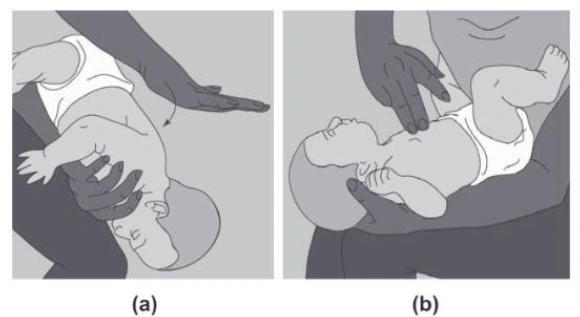
Back blow (a) and chest thrust (b) for relieving choking in infants.
Do not interrupt the resuscitation until
- The baby starts to wake up, moves, opens his eyes, and breathes normally; or
- Medical emergencies arrive and takes over.
Complications
- Foreign material may remain in the upper or lower airways following effective choking treatment, causing problems such as bronchiectasis or lung abscess later. Anyone who has a prolonged cough, trouble swallowing, or the sense that something is still lodged in their throat should see a doctor.
- The use of abdominal thrusts can result in serious injuries (e.g., gastric and splenic rupture). All victims of abdominal thrusts should have their abdomens examined, especially for internal damage.
- Hypoxic brain injury and death.
Preventive measures for avoiding foreign body airway obstruction.
- Avoid eating during exercise.
- Chew food properly.
- Avoid giving peanuts or very small objects to children.
- Increase public awareness of choking and confidence in initiating first aid.
Procedure
Demonstration of steps to relieve choking in adults and infants.
The subject teacher must demonstrate the “Five and Five” technique to relieve choking in adults and steps to relieve choking in infants (using a baby manikin/doll) to the students. If a manikin is not available, teachers can use YouTube videos for demonstration. The students will observe the demonstration of five blows and five thrusts given by the teacher. Each student will prepare a poster on first aid measures to be taken if an adult suffers from Foreign Body Airway Obstruction (FBAO).
Activity I
Organize students into groups and instruct them to act out a scenario of choking, followed by demonstrating the first aid steps to alleviate the choking. The teacher should assess if the students have correctly applied the “Five and Five” technique on their partners and provide guidance if any errors are noted.
Activity II
Prepare the poster on first aid measures to be taken if an adult suffers from Foreign Body Airway Obstruction (FBAO). The poster should serve as an efficient educational/counselling material to the people.
Result
The first aid measures for foreign body airway obstruction were studied, and educational materials on how to clear airway obstruction were prepared.
