No. 16: Determination of total dissolved solids in water
Aim:
To determine total dissolved solids (TDS) of drinking water using TDS meter.
Practical Significance:
Total dissolved solids (TDS) or total dissolved salts refer to the quantity of dissolved minerals found in water. When these minerals are present in elevated concentrations, they can pose potential harm. This practical will educate students on how to measure the TDS of drinking water, a crucial aspect of water safety analysis.
Theory:
The importance of water in our lives cannot be overstated. Without water, life on our planet would not be possible. We rely on water for various purposes, including drinking, industrial processes, irrigation, swimming, fishing, and more. Depending on its intended use, water must meet specific composition and purity standards. It is essential to regularly assess the suitability of each body of water.
One key indicator of water quality in lakes, rivers, and streams is the total amount of dissolved solids in the water. Elevated levels of dissolved solids can signify poor water quality. This also applies to drinking water, where any minerals, salts, metals, cations, or anions dissolved are termed “dissolved solids.” Total dissolved solids (TDS) refer to the overall concentration of dissolved substances in water. Water with high TDS levels may have reduced palatability and could have adverse effects on those consuming it. For this reason, a recommended TDS limit of 500 mg/L is set for drinking water.
As per the Bureau of Indian Standards (BIS) table, the TDS dependent acceptability of water for human consumption is as follows:
- Less than 50 mg/L: Unacceptable – Lack of minerals required for healthy human growth.
- 50-150 mg/L: Acceptable- Minor industrial contamination.
- 150-250 mg/L: Acceptable – Healthiest water and good for cardiovascular health.
- 250 – 350 mg/L: Acceptable – Contains essential minerals.
- 350-500 mg/L: Fair – TDS limit for human consumption is 500.
- Above 500 – 1200 mg/L: Not Acceptable– Unfit for human consumption. However, such water can be purified using Reverse Osmosis (RO) technology to eliminate TDS and bring it down to acceptable levels.
- Above 1200 mg/L: Not Acceptable-Unfit for human consumption.
TDS can be determined by gravimetric method or electrical conductivity method. The electrical conductivity method is very easy and convenient to determine TDS of water. The total dissolved solids can be determined quickly by measuring electrical conductivity with a meter. There are two types of such meters: An electrical conductance meter (EC meter) and a TDS meter. A TDS meter is an electrical conductivity meter (EC meter) that calculates TDS from the siemens value and reports the TDS concentration in parts per million (ppm) which can also be considered as milligram per litre (mg/L).
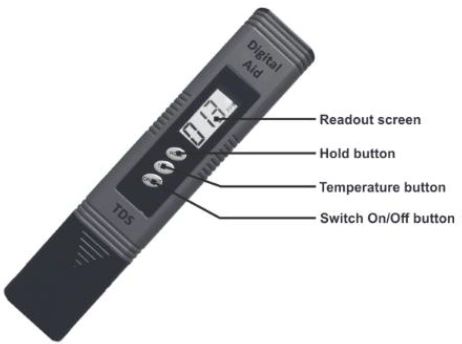
TDS meter
TDS meters are widely used because they are simple to operate. It consists of a readout screen which displays TDS in ppm (same numbers can also be read as mg/L). There are three buttons on the meter. “On/Off” button is used to turn the meter on and off. “Temp” button is used to measure the temperature of water. “Hold” button is used to freeze the reading when the metal probes are in contact with water. This helps to note down the reading once the meter is removed from water. Most of the TDS meters are calibrated at particular temperature (i.e. 250C). If the temperature of water is greater than 250C, the TDS reading will be higher than the original value and vice versa. Therefore, correction formulae are used to get actual TDS reading as given below:
For temperature greater than 250C, TDS (ppm) = Reading – [0.0190 × Reading × (Temp-25)]
For temperature less than 250C, TDS (ppm) = Reading + [0.0190 × Reading × (25-Temp)]
Procedure:
- Procedure Take 50 mL of drinking water in a 250 mL beaker.
- Remove the cap from the TDS meter. Switch on the TDS meter using the “On/Off” button.
- Dip the probes of the meter into the water. Take care to ensure that while submerging the meter in water, the water level does not exceed the provided marking on the TDS meter (Note: The TDS meter is not waterproof).
- Gently stir the meter to dislodge any bubbles sticking to the metal probes.
- If the reading on the readout screen is stable, note the reading; otherwise, press the “Hold” button and note the reading. Also, press the “Temp” button to record the temperature of the water (Note: If the “Temp” button is not available, use a thermometer from the laboratory to record the temperature).
- Use the appropriate formula from the theory section to calculate the actual TDS value of the water. Compare the value with the BIS table (refer to the Theory section) and state whether the water is acceptable for human consumption in the conclusion.
Observation
- TDS reading displayed on the readout screen = ____________ppm.
- Temperature reading = ____________0C
Result
- TDS value displayed on the screen of TDS meter = __________ ppm.
- Actual TDS value obtained from calculation = ______________ ppm.
